Friday, 27 September 2024

Bake Off

What do you see in the picture, who is it, where is it, what is happening?

The picture shows Nadiya Hussain, a famous British-Bangladeshi baker, winning the Great British Bake Off in in 2015.   

What is the Great British Bake Off, how do you win it?

Since wining, Nadiya has become famous for her baking skills.

Nadiya loves food and cooking . She says, "Food has the power to bring families together." 
Do you agree? Can you give an example?

Nadiya grew up in an immigrant family.

What is an immigrant?

She says when she was growing up her parents never threw any food away.
Why do you think that was?

Today Nadiya encourages people to "cook once, eat twice" 
What do you think that means?
It means you find aa way to use any left over food, for example, a carrot soup that you can then turn in to fish curry.

Nadiya is always seen as a positive role model when she appears on television, but she has talked recently about how in the past she suffer from anxiety.

What is anxiety?

Nadiya says when she first won British Bake Off in 2016, as well as receiving lots of praise and support on social media, she also received racist comments. 

"There was constant pressure to prove how British I was, how Bangladeshi, how Muslim. And then I realised by trying to please all these different groups, I was just displeasing myself."

Discuss this quote: why are people trying to make Nadia prove all these things, what was the affect on her, why was she trying to please everyone?

"People are going to say I'm not British enough to do a trifle, or not Bangladeshi enough to do certain curries, but I just don't really care. I'm quite happy in my grey area, which is very colourful, by the way."

What does Nadiya mean by her 'grey area'? 
How can a grey area be colourful? 

What do you think being British enough, or Bangladeshi enough means?
Nadiya uses trifle as an example of typically British food, what else might be seen as typically British?
Can you think of any food that might be seen as typically Bangladeshi? French? Mexican? Greek?
What is Nadiya trying to tell us about food and different cultures? 
What can we learn from Nadiya in this story?
Why is this about No Outsiders?
Which British Value is this about?


Friday, 20 September 2024

sculpture


https://www.dailyartmagazine.com/sculptures-of-bruno-catalano/

What do you see in the photo? Where is it, what do you think the story is here?

Bruno Catalano is an artist who has created ten life-size sculptures of people along a waterfront in Marseille, France.

All of the sculptures have parts of their bodies missing, what do you think the sculptures represent?

What do you think the sculptures might be called?

They are called, "Les Voyageurs" - what do you think that means? (The travellers)

Bruno was born in Morocco and moved to France as a child. 
These are the words Bruno is exploring through his sculptures:
Travel,
Migration,
Journey,
Home,
Belonging,
Loss.
World Citizen

Explore these words- what do they mean, how do you think Bruno is trying to represent those words in his work? Are there any other words that you can think of looking at these sculptures?

What do you notice abut the suitcase - it weighs them down but it is also the only means of support for the statue - why do you think Bruno dd this?

Bruno wanted people to see the sculptures in different ways; some figures appear to be fading away, others appear to be materialising in front of our eyes. Bruno says whenever he travelled to a new country, his travels left him feeling that a part of him was gone and would never return.

Bruno wants people to look at his work and, "examine their role as global citizens"

- what is art and what is art for?
- why do you think Bruno created these sculptures?
- why has he put them near water?
- a part of him was gone and would never return - why do you think Bruno felt like this? 
- what is the name for a person who has to travel to find a safe home? (refugee)
- Do you think people choose to be refugees?
- Is this about refugees?
- Imagine what it feels like to have to travel and find a new home where there is a new language and you don't know anyone and you have no home. Wy do you think Bruno chose to represent his sculptures like this?
- what is a global citizen? What do you think Bruno wants his art to create?
- why is this about No Outsiders?
- Which British Value is this about?

No Outsiders: We belong here by Andrew Moffat  (scheme of work for primary schools) 


Sunday, 15 September 2024

Penguin


What do you see in the picture, what do you think the story is here?

During the summer holidays there was sad news from Sydney when Sphen, a famous gentoo penguin sadly died. Sphen became very famous in 2018 when he fell in love with another male penguin called Magic at Sydney Aquarium. The couple adopted eggs twice and brought up two penguin chicks together.

Magic and Sphen became famous around the world and people fell in love with their story and visited the aquarium to see the chicks raised by two daddies.

Sea Life Sydney Aquarium said Sphen and Magic had an "immeasurable impact around the word as a symbol of equality."

When Magic realised Sphen had died, he started to sing and the whole penguin colony joined in. The zoo keepers said it was an emotional moment.

Many people commented online about Spen's impact:
Mark said, "Sphen and Magic were equality icons"
Habibi said, "You taught the world so much, we will never forget you" and added an Arabic term of affection.

There is a short video in the link above showing Sphen and magic when they adopted their first chick.

- This story is about an animal in a zoo that died. Yet it made the news all over the world - why?
- Why do you think two male penguins adopting a chick is so interesting to people?
- Sphen and Magic had an "immeasurable impact around the word as a symbol of equality."- what does this mean?
- what does this say about families in 2024 around the world?
- why did all the penguins join in singing when Sphen died? What does that show abut how the other penguins felt about him?
- People commented using English and using Arabic; what does this show about different people and respect for different families?
- some people might argue Sphen and Magic are not a proper family; how would you respond?
- what do we say at our school about different families?
- what is the law in the UK about this? (Equality Act - sexual orientation)
- who else is protected in the Equality Act?
- Some people might say children don't need to know about things like this. How would you respond?
- why is this about No Outsiders?
- Which British value is this about?

No Outsiders: We belong here by Andrew Moffat  (scheme of work for primary schools) 


Sunday, 8 September 2024

Paralympics refugee team


https://www.paralympic.org/paris-2024/news/khudadadi-wins-first-ever-medal-refugee-paralympic-team

What do you see in the picture, where it it, which country has that flag?

The first picture shows Zakia Khudadadi who won bronze in taekwondo at the Paralympics this year. 

The second picture shows Guillaume Junior Atangana who won bronze in the men's 400m.

Zakia was the ever refugee Paralympic team athlete to win a medal and Guillaume was the second.

Zakia says, "I am so proud of this flag because today I am a refugee. Today I am a refugee. I worked hard these three years and there were problems that I had but that is in the past."

Guillaume says, "I am very happy to have this medal. It shows that the Paralympic movement is galvanising for refugees and it is an honour for me: I wrote my name in history. The message I have for all refugees in the world is to believe in yourself."

Guillaume says that competing in Paris sends a message to other refugees and people with disabilities that anything is possible.  "I want to show the world that being blind doesn't mean your life is over, you can still do great things."

In the photo, Zakia is holding the flag under which the refugee team compete at the Paralympics.

When Zakia competed, many of the French public were supporting her, cheering her on with every bout of the game.

Zakia says, "For three years I have been a professional taekwondoka, and today I have won because behind me there is the French republic, the refugee team and my best coach, Haby Naire. We've all won today."

Zakia escaped from her home country in 2020 and started a new life in France, where she says there were challenges she had to face; "When I became a refugee in Paris, I tried to become stronger than before. Those two years were proof that we can do what we want, despite the difficulties."

"I want to give this medal to the whole world. I hope that one day there will be freedom in my country, for all the world, for all the girls, for all the women, for all the refugees in the world. And that all of us work towards that, for liberty and equality."

"I am the first female Paralympic refugee, Afghan, winning a bronze medal. For me, this is like life. I am here to continue for gold in Los Angeles."

Zakia is the flag bearer for the refugee team at the closing ceremony and will lead them out. Eight refugee athletes and one guide runner competed in the Paralympics this year.

The UN high commissioner for protection says, the reception for the refugee team in Paris has been overwhelmingly positive; "They are a symbol of perseverance and hope and spectators have united in support for the athletes. It's a reminder that people everywhere crave the same things in life: safety and a chance to fulfill their dreams."

What is a refugee?
How does someone become a refugee, is it a choice you make?
What is the Paralympics for?
"I want to show the world that being blind doesn't mean your life is over, you can still do great things." Why does Guillaume say that?
Why have a refugee team? Why doesn't Zakia compete under an Afghan flag?
Zakia says she is proud of the flag. Why is she proud to be a refugee?
How is the Paralympics galvanising for refugees? 
What do liberty and equality mean?
Some people say refugees are not welcome. Why?
Why were French people in the crowd cheering for an athlete who was not French?
"They are a symbol of perseverance and hope" - why?
"people everywhere crave the same things in life: safety and a chance to fulfill their dreams."- do you agree?
What is the law in the UK about difference, who is included in that law? (Equality Act 2010)
What do we say at our school about being different, speaking a different language, being born in a different country or having a different religion?
Why is this story about No Outsiders?
Which British value is the story about?

No Outsiders: We belong here by Andrew Moffat  (scheme of work for primary schools) 


Sunday, 1 September 2024

community cohesion 2024


Community Comes Together to Rebuild Brick Wall of Mosque Damaged by Rioters (goodnewsnetwork.org)

‘My shop was looted by rioters, then saved by strangers’ - BBC News

Ask the children what they see in the pictures and explain although the pictures are about different people, they are connected.

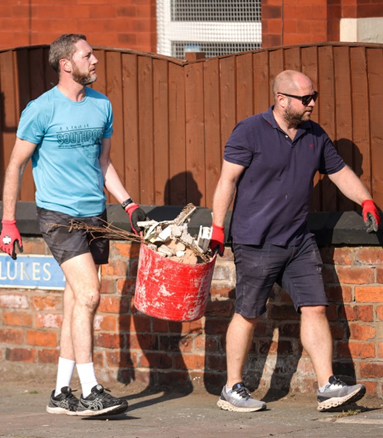
The first picture shows bricklayer Tony Hill re-building a wall outside a mosque after it was attacked during violence in Southport. Tony says, “Building crews were coming down so we joined them. We just really want to get this up so the community is safe. It’s just a community isn’t it. You can tell by just looking at everyone here. It’s quite diverse.”

Tony said if he had to rebuild the wall again, he wouldn’t hesitate. The video went viral with over 5 million views. Many people commented calling Tony a legend and saying this was what being British was all about.

The second picture shows Chanaka Balasuriya, who owns a Minimart grocery store in Southport. Chanaka emigrated to England from Sri-Lanka in the 1990s and worked hard to build up his own business from scratch.  During the anti-immigration violence, Chanaka’s shop was destroyed, and his goods were looted. Before this happened, he had not experienced racism while living in England.

Chanaka says, “I remember thinking ‘well that’s it, we’re finished.’ A business I started from scratch. I kind of gave up on everything.”

But the following morning, when he arrived at his shop, Chamaka found a crowd of people already there, clearing up and making repairs.. Support flooded into Chanaka. The owner of a beauty salon nearby set up a crowd funding campaign and more than £11,000 was raised. A local builder replaced Chanaka’s windows for free.


Chanaka says, “You never imagine you’re going to get that much support.”

“It’s not about the money people gave me. It was the messages, the cards, the flowers, that support from strangers is unbelievable.”

-        What is racism?

-        Where do racist ideas come from?

-        Why was a mosque attacked?

-        Tony is not Muslim so why is he rebuilding the wall?

-        “It’s just a community isn’t it. You can tell by just looking at everyone here. It’s quite diverse.” What does Tony mean by this?

-        Chanaka is an immigrant, what does this mean?

-        What do the people who caused the violence say about immigration?

-        When Chanaka came to England he worked hard to build his business from scratch and made it successful. How does this challenge the ideas given by people causing the violence?

-        Why did so many people want to help Chanaka rebuild his shop?

-        What does that show about most people living in Southport and England today?

-        Why are the messages more important to Chanaka than money?

-        What do these stories tell us about living in England today?

-        What do we say at our school about difference and diversity?

Why is this about No Outsiders?

No Outsiders: We belong here by Andrew Moffat  (scheme of work for primary schools) 

Register to be a No Outsiders school  (new for 2024)

Watch CPD films showing schools in 2024 using No Outsiders to teach community cohesion 


Monday, 5 August 2024

Fish and chips


Gary Lineker made a short film last week to celebrate National Fish and Chip day. In the film Gary starts by saying, “Britain wouldn’t be Britain without Fish and Chips. A national institution!”

Then the food on the plate starts talking and explains to Gary that they wouldn’t be here without refugees;

“Have you ever thought about where I actually come from?” says the fish;

“You’ve got refugees to thank for me. I’m a bit Spanish, a bit Portuguese, 15th Century Jewish refugees bought me over.”

The chips then explain they came over with French refugees. And the first Fish and Chip shop was opened by a refugee called Joseph Malin in the 1860s.

Gary ends by saying, “Britain wouldn’t be Britain without refugees.”

Gary got lots of praise on social media for this film but some people said refugees were not welcome. One MP said if Gary was so concerned about refugees he should invite a refugee to stay in his house. So Gary contacted the charity “Refugees at home” to offer to host a guest.

-        What is a refugee?

-        Can anyone become a refugee? How?

-        why is Fish and Chips a ‘British institution’, what does that mean?

-        Battered fish originated in Spain and Portugal and chips were invented by Jewish refugees. Today there are fish and chip shops in every high street in Britain. What does this show about the benefits refugees can bring?

-        Why do you think the MP asked if Gary was going to offer to host a refugee in his house?

-        Why do you think Gary offered to do this?

      What do we say at our school about difference?

       What is the law about difference in the UK? (The Equality Act) What is a protected characteristic? Who is protected?

       How do people in our school know they belong here?

Why is this about No Outsiders?

Which British value is this about?

Sunday, 4 August 2024

"They are people"


Ian Durrant is an army veteran living in Lincoln and he has two flags in his garden; the St George Cross and a Union Jack; he says it's because he is proud to be English. But Ian says sometimes the flags give the wrong impression; people think he doesn't like people who are different.

In a few weeks a large Mosque will open near Ian's home, Ten years ago, Ian campaigned against the Mosque. Local Muslims knew that some people in the community didn't want a Mosque so Tanweer Ahmed, Chairman of the Lincoln Islamic Association, suggested knocking on every door in the area and talking to people. Tanweer also contacted Ian and invited him to a talk about Islam. Ian went to the talk and found it fascinating.

Ian and Tanweer are now friends. Ian attends Eid celebrations and open days at the Mosque. He says, "I took pride in being friends with, and talking to Muslim people. Other people would say, why are you doing that? And I said, They're people!"

"If I look out of the window to the left, I see the Cathedral in it's glory. if I look to the right, I see the Mosque. East has met West in Lincoln."

What do you see in the picture?
What do the flags mean?
What kind of person do you think Ian is?
Can you tell what kind of person Ian is, just by looking at this photo?

What has been in the news recently that might be connected with this story?

Explain the story

- Why does Ian have these flags in his garden?
- What does Ian think about different people belonging in Britain?
- Ian used to think different people didn't belong; what changed his mind?
- What does this show us about dialogue and ideas?
- Ian says about his Muslim friends; "They are people," what does he mean?
- Why does Ian say he has "Pride" in being friends with Muslim people?
- What does this story show us about Britain today?
- Who is Britain for? (everyone)
- What British law says people should not face discrimination because of their faith and their race? (The Equality Act 2010) Who else is protected in that law? (go through protected characteristics)
- What can we learn from Ian?
- What can we learn from Tanweer?

- Why is this story abut No Outsiders?
- Which British Value is this story about?

We provide all our assemblies every week for free. No Outsiders needs funds to keep going. Please consider contributing to our Go Fund Me page